ChatGPT Prompts for Business Writing: 2,000 Full Scenarios
Picture an operations manager who has to write a delicate email to a supplier about a late delivery, a summary for the leadership team and a job ad for a new hire, all before lunch. They open ChatGPT, type “write a professional email about a late delivery”, and get something polite, generic and unusable. The problem isn’t the tool. It’s the prompt. Good ChatGPT prompts for business writing give the model the business context, the situation and the complication, and they spell out what the response must include. This is an illustrative scenario, but it is the gap the 2,000 ChatGPT Business Writing Prompts collection was written to close.
Here is why short prompts produce weak business writing, how to write better prompts yourself, and what is inside the collection.
Get the 2,000 ChatGPT Business Writing Prompts →
Why one-line prompts produce generic business writing
Business writing depends on context: who you are, who you are writing to, what has happened and what you need from them. A one-line prompt leaves the model to guess all of that, so it falls back on safe, bland phrasing.
- No business context means the tone could suit a bank or a bakery equally well, which is to say neither.
- No complication means the hard part of the message (a missed target, a price rise, a refused request) is glossed over.
- No required elements means important points get left out and you rewrite half the draft yourself.
Free prompt lists online often have the same weakness: they are short, so the output is short on substance too.
How to write ChatGPT prompts for business writing that work
You can apply this structure to any prompt you write, with or without a prompt pack.
- Set the business. State the type of company, its size and your role. “I run a 12-person landscaping company” gives far more to work with than “I run a business”.
- Describe the situation. What happened, and who is the audience? A client, your team, a supplier, the board?
- Add the complication. The tension is usually why the message is hard to write: a delay, a budget overrun, a complaint, a change of plan.
- List what the response must include. For example: acknowledge the issue, explain the cause in one sentence, give the new date, offer a goodwill gesture, end with a clear next step.
- State format and tone. Length, structure (email, bullet summary, one-paragraph LinkedIn post) and tone (warm, direct, formal).
- Review and edit. Treat the output as a first draft. Check facts, names and figures, and adjust anything that doesn’t sound like you.
Here is a made-up example of that structure (not taken from the collection): “I manage customer service for an online furniture retailer. A customer’s sofa arrived damaged and the replacement is delayed by three weeks. Write a reply that apologises, explains the delay, offers a choice between waiting or a full refund, and confirms how they will be kept updated. Keep it under 150 words and warm in tone.”
Mistakes that weaken AI-written business documents
- Pasting confidential details. Replace client names, figures and personal data with placeholders unless your organisation has approved the tool for that information.
- Accepting the first draft. Ask for a shorter version, a more direct tone or a different opening. A follow-up instruction usually improves the result more than rewriting it by hand.
- Forgetting the reader. A message to the board and a message to a frustrated customer need very different language. Say who will read it.
- Letting the model invent facts. If you don’t give dates, numbers or policies, the model may make them up. Supply the facts, and check every figure before sending.
- Using the same prompt for everything. Proposals, reports, job ads and social posts each need their own structure. A prompt written for one type of document rarely works well for another.
Building your own prompt library
Once a prompt produces something you like, save it. Keep a simple document or Notion database of prompts grouped by task (client emails, reports, hiring), with a note on what to change each time. Over time you end up with a set of reliable starting points for the writing you do most often.
Inside the 2,000 ChatGPT prompts for business writing
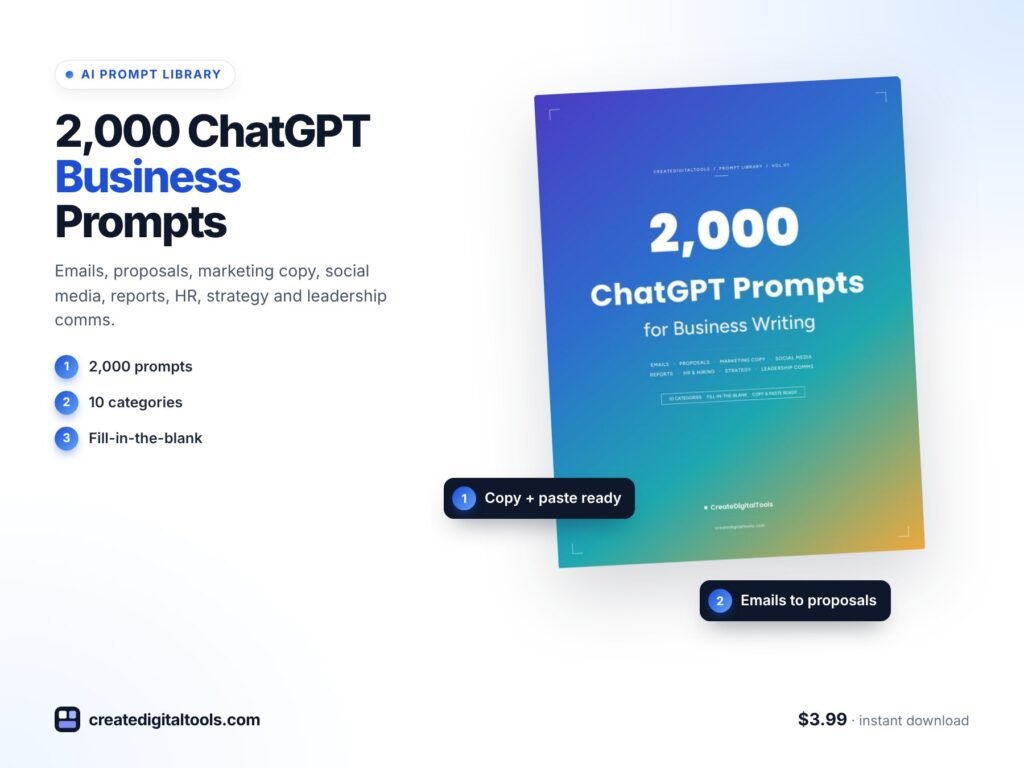
The collection contains 2,000 full-scenario prompts. Each one sets a business, a situation and a complication, then lists what the response should include, following the same structure described above.
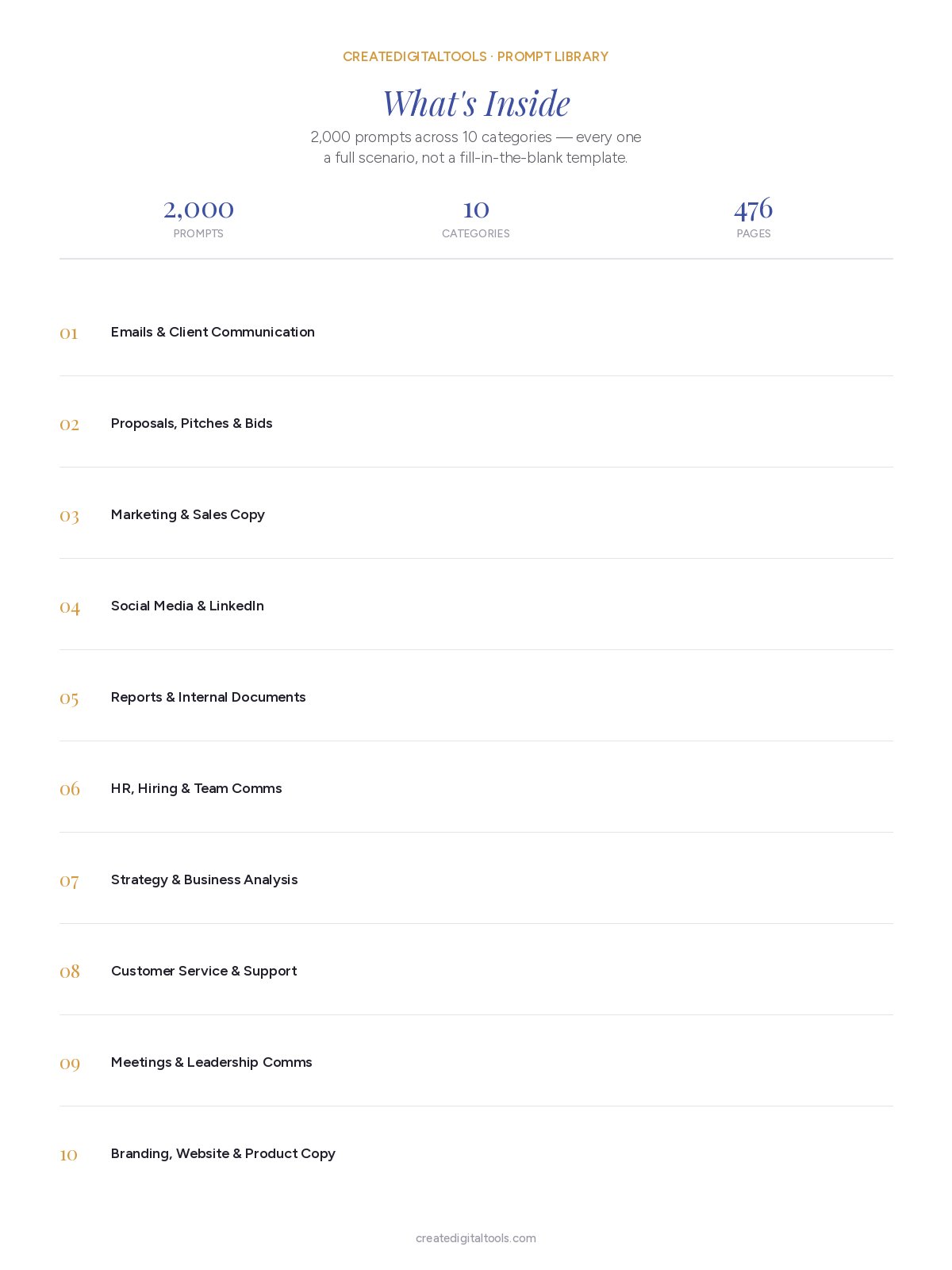
10 categories, 200 prompts each
The prompts are organised into 10 categories and 50 subcategories:
- Emails & Client Communication
- Proposals, Pitches & Bids
- Marketing & Sales Copy
- Social Media & LinkedIn for Business
- Reports, Summaries & Internal Documents
- HR, Hiring & Team Communication
- Strategy, Planning & Business Analysis
- Customer Service & Support Writing
- Meetings, Presentations & Leadership Communication
- Branding, Website & Product Copy
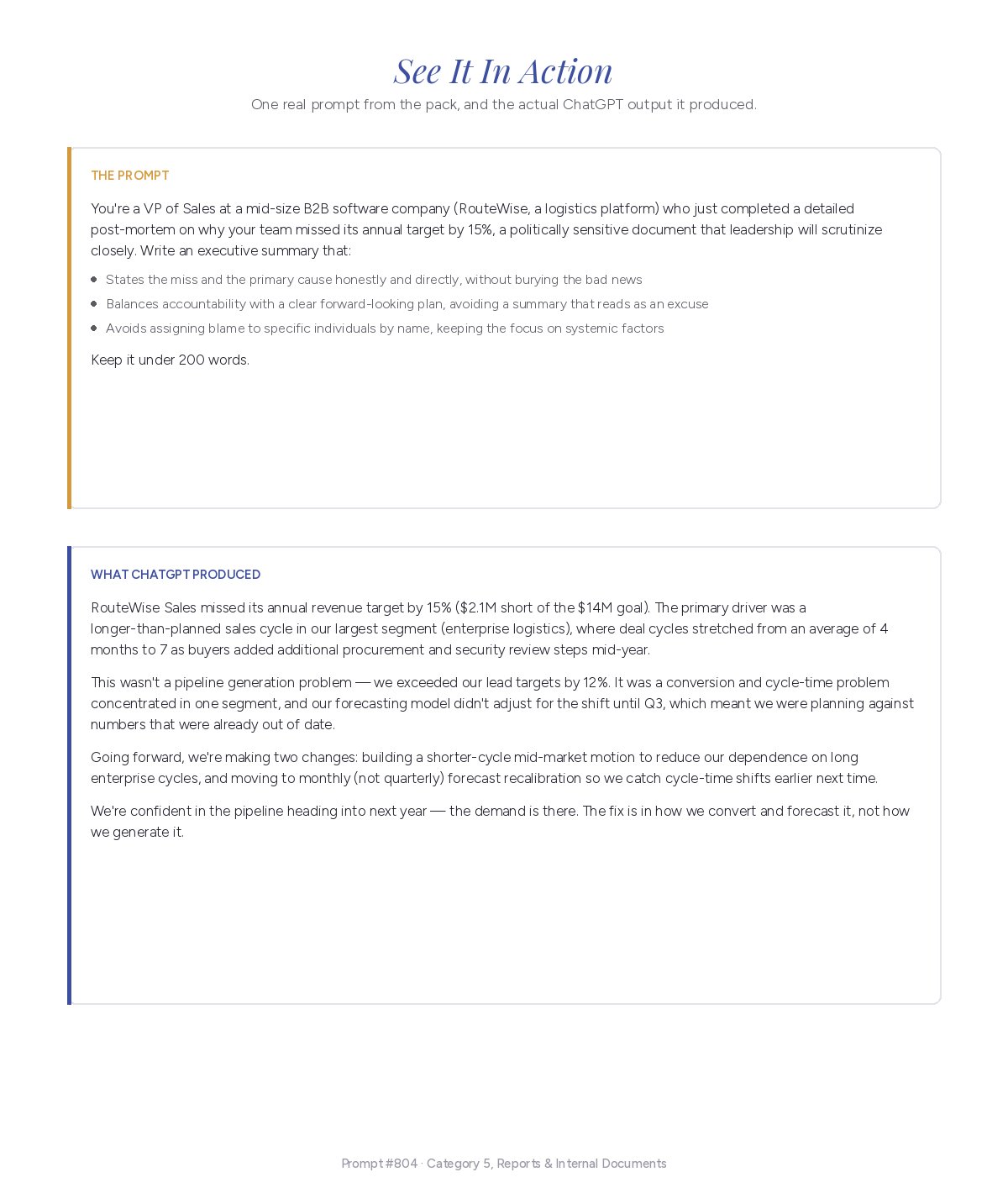
Two formats: PDF and EPUB
You receive two files. The PDF is 476 pages, bookmarked and searchable, with clickable navigation to every category and subcategory. The EPUB is reflowable for Kindle, Apple Books, Kobo and other e-readers, which is handy for browsing prompts away from your desk.
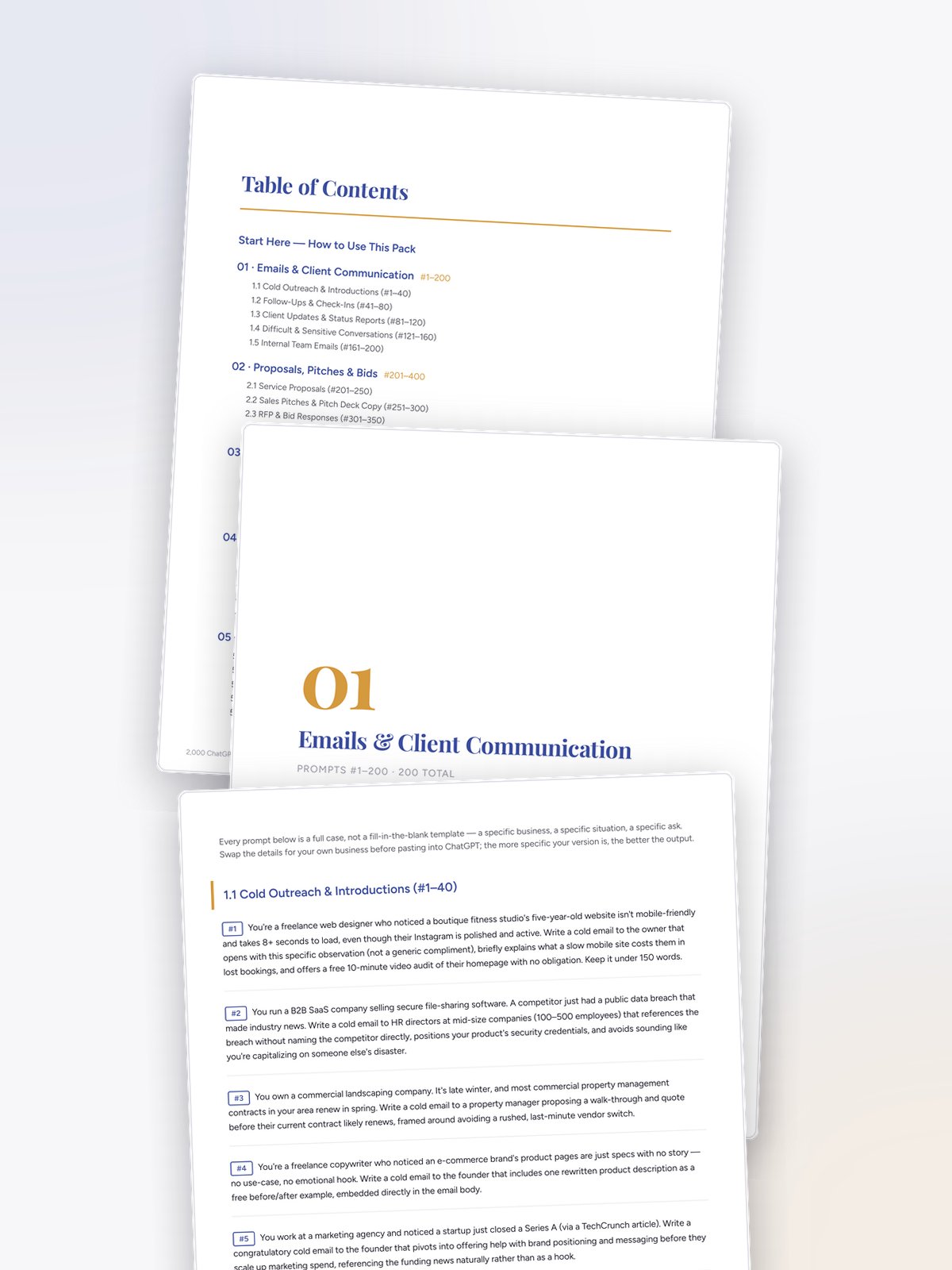
How to use it day to day
Find the category that matches your task, pick the closest prompt, swap in your own business details and paste it into ChatGPT. The product page states the prompts work with any ChatGPT plan you already have, and that no prompt engineering knowledge is required.
Optional Notion pairings
The product page suggests pairing some categories with Notion templates, such as the HR prompts with an HR management template or the proposal prompts with freelance client templates. These pairings are optional; the prompts work on their own.
Who it’s for, and who it isn’t for
A good fit for:
- Small business owners, managers and freelancers who write a lot of emails, proposals and reports.
- Anyone who uses ChatGPT for work but finds the results too generic.
- People who want examples of well-structured prompts to learn from and adapt.
Not a good fit for:
- Anyone looking for a Notion template. This is a PDF and EPUB collection, not a Notion workspace.
- People who want finished copy without editing. The prompts produce drafts that still need your review.
If you want prompts organised by industry instead, see 5,000 AI Business Prompts by Industry. You can browse everything in the AI prompts category.
FAQ
What format are the prompts in?
A 476-page bookmarked, searchable PDF and a reflowable EPUB for e-readers.
Which ChatGPT plan do I need?
The product page says the prompts work with any ChatGPT plan you already have, so there is nothing extra to subscribe to.
Is it an instant download?
Yes. Both files are available immediately after purchase, with no account or login needed.
Do I need to know prompt engineering?
No. Each prompt is already written in full. You replace the business details with your own and run it.
Can I edit the prompts?
Yes, and you should. Swap in your company type, audience and specifics so the output fits your situation.
Get the 2,000 ChatGPT Business Writing Prompts →
ChatGPT is a trademark of OpenAI. Notion is a trademark of Notion Labs, Inc. Kindle, Apple Books and Kobo are trademarks of their respective owners. This is an independent product, not affiliated with or endorsed by any of them.
Notion systems, spreadsheets and planners with a setup guide. Instant download.